
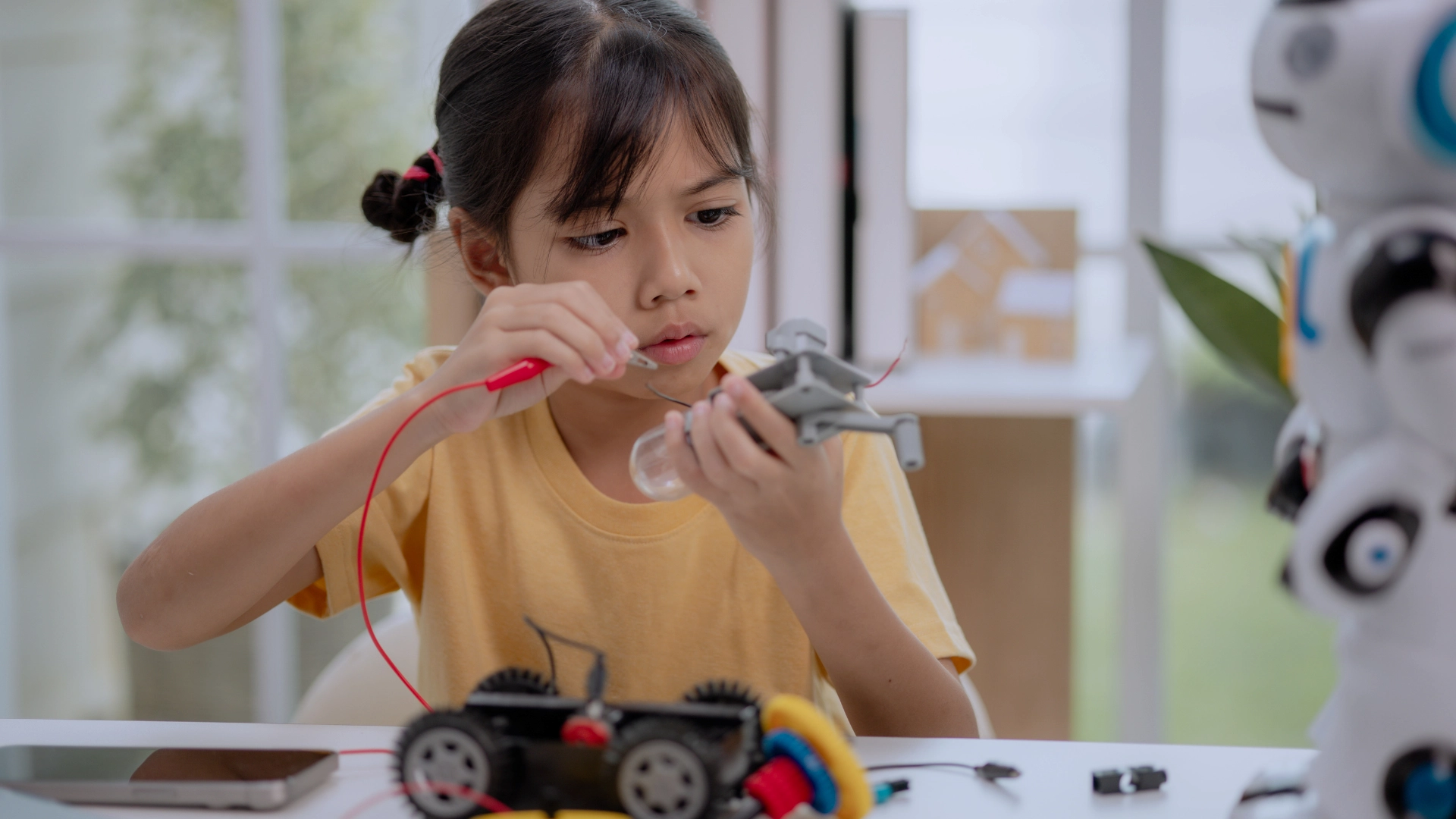
When we first step away from the traditional classroom, the idea of teaching science or engineering can feel a little intimidating. You might picture pristine laboratories, expensive equipment, or complex formulas that you haven’t thought about since high school. It is easy to worry that we aren’t doing enough or that we need a specialized degree to help our children understand how the world works.
But here is the beautiful truth about homeschooling. You do not need a white coat or a rigid curriculum to spark a love for discovery. Some of the most profound learning moments happen right at your kitchen table or in the backyard dirt. When your child wonders why a block tower falls over or asks how a bird builds its nest, they are already thinking like an engineer.
Our role isn’t to lecture or to have all the answers. Our role is simply to provide the space, the materials, and the encouragement to explore. We get to reclaim the joy of curiosity right alongside our kids. This guide is all about accessible, low-pressure ways to bring science experiments for kids and engineering concepts into your daily rhythm. We will focus on using what you have, embracing the mess, and celebrating the process of figuring things out together.
What Do We Mean by Engineering?
Before we dive into the activities, let’s take a breath and simplify what we are actually doing here. In a school setting, engineering is often broken down into units and standards. In our homes, engineering is simply the art of solving problems.
It is the process of looking at a challenge, imagining a solution, building it, testing it, and then trying again when it inevitably flops the first time. It is grit. It is creativity. It is learning that failure is just information.
When we talk about STEM (Science, Technology, Engineering, and Math) in a homeschool context, we aren’t talking about dry textbooks. We are talking about hands-on exploration. We are talking about the freedom to spend three hours building a marble run just to see if it works. This approach aligns perfectly with a lifestyle of learning that values critical thinking over rote memorization.
The Kitchen Laboratory: Edible Engineering
The kitchen is the heart of the home, and it is also one of the best places to introduce science experiments for kids. You likely already have everything you need in your pantry. The best part about kitchen science is that it often ends with a snack, which is always a win for growing kids.
Bold Takeaway: Science doesn’t have to be separate from daily life. Cooking and baking are foundational engineering and chemistry lessons waiting to happen.
The Spaghetti Bridge Challenge
This is a classic activity that never gets old. The goal is simple. Build a bridge using only dry spaghetti noodles and marshmallows (or gumdrops) that can support the weight of a small toy car or a heavy serving spoon.
- Set the Stage: Clear off the table and dump out the supplies. Ask your children questions to get them thinking. “What shapes do you think are the strongest?” “How can we make the base sturdy?”
- The Build: Let them lead. If they want to build a flat road, let them. If they want to build a tall arch, encourage it. You can build your own alongside them.
- The Test: This is where the magic happens. Place the weight on the bridge. If it snaps, cheer! This is the engineering process in action. Ask, “Where did it break? Why do you think that happened? How can we reinforce that spot?”
- Why It Matters: This simple activity introduces concepts of tension, compression and structural integrity. You can discuss these concepts naturally without forcing it into a vocabulary or rote memorization lesson. It is just playing with food, but the brain is making massive connections.
The Great Cookie Experiment
Baking is precise, but it can also be an experiment. What happens if we use melted butter instead of cold butter? What if we add more baking soda?
- The Setup: Make a half-batch of your favorite cookie recipe exactly as written. Then, make a second half-batch where you change one variable. Maybe you leave out the egg or double the flour.
- The Observation: Watch how they bake differently. Look at the texture. Taste the difference.
- The Discussion: Talk about how ingredients work together. This turns a treat into a thoughtful investigation of chemistry.
If you are looking for more ways to spark this kind of curiosity, LearningHub.com offers a variety of science focused online lessons.
Backyard Engineering: Building with Nature
One of the greatest gifts of homeschooling is the ability to step outside and breathe. The natural world is the ultimate classroom for STEM learning. There is no cleanup required in the same way, and the materials are free. Taking learning outdoors helps ground us and connects our children to the seasons and the environment.
Bold Takeaway: Nature provides the best loose parts for play. Sticks, rocks, and mud are open-ended tools that encourage complex structural thinking.
Den and Fort Building
Whether you have a large, wooded property or visit a local park, building a den is a rite of passage. It requires heavy lifting, negotiation, and planning.
- The Challenge: Ask your kids to build a shelter that could keep them dry in a rainstorm.
- The Process: They will need to find long sturdy sticks for the frame. They will need to weave smaller branches to create walls. They might use leaves or moss for insulation.
- The Connection: This connects back to history and survival skills. It teaches weight distribution and balance. It also builds physical strength and coordination.
Water Flow and Dam Building
If you have access to a small creek or even a puddle after a rainstorm, you have an engineering lab.
- The Activity: Challenge your kids to change the flow of the water. Can they build a dam using rocks and mud? Can they build a channel to divert water to a specific plant?
- The Learning: This teaches fluid dynamics and hydrology. It is mesmerizing work. Children can spend hours moving stones and watching the current shift. It is deeply calming and intellectually stimulating at the same time.
For families who want to dive deeper into outdoor learning, check out this article on The Great Outdoors: Your Ultimate Classroom for Homeschool Learning. It explores how nature supports holistic development. Additionally, resources like the 1000 Hours Outside movement remind us that matching screen time with green time is essential for a healthy childhood. Their philosophy aligns beautifully with the idea of letting kids explore the physical world to build resilience and creativity.
Trash to Treasure: Cardboard Creations
Before you recycle those delivery boxes, pause. Cardboard is perhaps the most versatile building material on the planet. It is forgiving, easy to cut, and free. Creating with cardboard teaches resourcefulness. It shows our kids that they can make something amazing out of what others might consider waste.
Bold Takeaway: Limited resources breed creativity. Giving children a pile of recycling and some tape often leads to more innovation than an expensive kit.
The DIY Marble Run
Commercial marble runs are fun, but building your own is a true engineering feat.
- Materials: Toilet paper rolls, paper towel rolls, cardboard boxes, tape, and marbles.
- The Goal: Create a track that keeps the marble moving for as long as possible.
- The Twist: Tape the rolls to a wall or the side of a large box. Cut holes in boxes for tunnels. Create jumps.
- Troubleshooting: The marble will fly off the track. It will get stuck. This is perfect. Adjusting the angle of the tube is physics work. Figuring out how much tape is needed is material science.
Cardboard Automata
This is for slightly older kids or for parents who want to tinker alongside them. Automata are mechanical toys that move using simple machines like cams, levers, and linkages.
- The Build: Use a small box as a frame. Use skewers for axles and foam circles or cardboard circles for wheels.
- The Movement: When you turn a handle on the side, the motion transfers to make a character on top jump or spin.
- The Value: This demystifies how machines work. It breaks down complex motion into simple component parts.
If you enjoy these kinds of creative projects, LearningHub.com has a wealth of ideas. Our platform is designed to support this exact kind of child-led discovery, giving you the tools to facilitate rather than dictate.
Tech and Logic: Unplugged Coding
We often hear about the importance of coding, but we might hesitate to increase screen time. The good news is that the logic behind coding, sequencing, patterns, and commands, can be learned completely offline. These are educational games for students that happen on the living room rug.
Bold Takeaway: Computational thinking is just a fancy way of saying “thinking in steps.” You can practice this skill without a single computer.
Robot Commander
In this game, one person is the “robot” and the other is the “programmer.”
- The Setup: Create a grid on the floor using masking tape or just use square tiles. Place an “obstacle” in a few squares and a “treasure” in one square.
- The Code: The programmer must give the robot verbal instructions to get to the treasure without hitting an obstacle. But they have to give all the instructions at once before the robot moves.
- The Commands: Use simple language like “Step Forward,” “Turn Right,” or “Step Backward.”
- The Debugging: If the robot hits a wall, the programmer has to go back and fix their code. This is a hilarious and physical way to understand algorithms.
Pattern Recognition with LEGO
LEGO bricks are the original engineering tool. Beyond just building castles, use them for patterns.
- The Activity: Build a sequence of colored bricks (Red, Blue, Red, Blue). Ask your child to continue it.
- Level Up: Make it complex. (Red, Red, Blue, Yellow, Red, Red…).
- Why: Recognizing and predicting patterns is the basis of mathematics and computer science.
When you are ready to incorporate some digital tools, there are wonderful options that feel like play. You can find educational games for students that respect your values and don’t feel like “drill for skill” software.
Minecraft in Learning Hub
Minecraft Education is a learning-focused version of Minecraft designed specifically for students. In Learning Hub, you’ll find Minecraft Education worlds that connect to STEM learning goals. These activities support reading comprehension, problem-solving, creativity, and critical thinking, all while learning through play!

Lesson link: Minecraft Education STEM Playlist (Be sure to have Playlist open)
Everyday Fix-It: Real Life Skills
There is a movement in the homeschooling world towards practical life skills. We want our kids to be capable adults. Involving them in household repairs is one of the most authentic engineering lessons available.
Bold Takeaway: Demystifying how things work in our own homes empowers children. It teaches them that the world is understandable and fixable.
The Take-Apart Box
Do you have an old toaster that doesn’t work? A broken radio? A toy that stopped singing? Put them in a box.
- The Tool Set: Give your child real screwdrivers and pliers (supervising for safety based on age).
- The Mission: Take it apart. That is it. Just open it up and see what is inside.
- The Discovery: They will find circuit boards, springs, gears, and wires. They might not know what everything does, and that is okay. Just seeing the complexity inside a plastic shell creates a sense of wonder.
- Safety Note: Always cut the cords off electrical appliances before putting them in the box to ensure they cannot be plugged in. Avoid anything with glass screens or capacitors like old TVs.
Home Maintenance Helper
Next time you have to tighten a loose cabinet hinge or change an air filter, invite your child to help.
- Hand Over the Tools: Let them hold the flashlight. Let them turn the wrench.
- Explain the “Why”: “We are tightening this because the screw came loose, which made the door wobble.” This is cause and effect. This is mechanical engineering.
This practical approach helps children feel useful and capable. It builds confidence that no worksheet ever could.
Documenting the Journey
In a traditional school, learning is proved by a test score. In our homes, we have the freedom to prove learning through growth and joy. However, it is still nice to keep a record of what we have done. This isn’t for a grade, but for memories and reflection.
Bold Takeaway: Portfolios and journals are far more telling than report cards. They capture the spark of an idea and the effort of the process.
Create a “Discovery Journal” or a “Lab Notebook.” It does not have to be fancy. A simple sketchbook works perfectly.
- Draw Diagrams: Encourage your children to draw a picture of their LEGO build or their cardboard fort.
- Take Photos: Print out photos of their messy experiments and paste them in.
- Write Questions: If an experiment failed, write down why. “The volcano didn’t erupt because we forgot the vinegar.”
- Celebrate Growth: Look back at the journal at the end of the year. You will see how their drawings became more detailed and their questions became deeper.
If you are looking for guidance on how to structure these records without making it feel like work, LearningHub.com offers tools and articles to help you document the magic. We believe in capturing the story of your child’s learning.
If you are looking for guidance on how to structure these records without making it feel like work, LearningHub.com offers tools and articles to help you document the magic. We believe in capturing the story of your child’s learning.
Embracing the “Fail”
Perhaps the most important engineering lesson we can teach our children is how to handle failure. In engineering, failure is not a bad thing. It is a necessary step toward success. Bridges collapse before they stand. Rockets crash before they fly.
When a tower falls or a mixture doesn’t bubble, watch your own reaction. If you get frustrated, your child will learn that mistakes are stressful. If you laugh and say, “Whoops! Let’s try that again,” they will learn resilience. Be careful that you don’t try to step in and fix the mistakes that you see coming.
We are cultivating a mindset that says, “I don’t know the answer yet, but I can figure it out.” That is a life skill that will serve them far beyond their homeschooling years.
For more encouragement on this mindset, consider reading insights from Leslie Martino on Embracing Curiosity. She speaks beautifully about how wonder and curiosity are the true drivers of education, a philosophy that resonates deeply with the engineering spirit.
Keeping It Simple and Fun
You do not need to do a big project every day. Homeschool activities should fit into your life, not take it over. Maybe you do one big experiment on Friday afternoons. Maybe you just scatter LEGOs on the rug and let them build while you read aloud.
The goal is to keep the spark alive. We want our children to look at the world with wide eyes and ask “Why?” and “How?” and “What if?”
Remember that you are the facilitator, not the encyclopedia. It is okay to say, “I don’t know, let’s look it up.” It is okay to learn alongside them. In fact, that is the best way to teach.
If you are looking for a community that understands this gentle, child-led approach, we would love to support you. LearningHub.com is designed to be a partner in your journey.
Would you like to have a library of ideas at your fingertips?
Join LearningHub.com for free and access thousands of interactive K–12 lessons, hands-on science playlists, and personalized tools to help you build a science-rich homeschool experience your kids will love. There is no pressure and no cost, just a wealth of resources to help you say “yes” to curiosity.
References
1000 Hours Outside. (n.d.). Match Screen Time with Green Time. Retrieved from https://www.1000hoursoutside.com/
Martino, L. (n.d.). Where Wonder Begins: Embracing Curiosity in Your Homeschool. Retrieved from https://lesliemartino.com/where-wonder-begins-embracing-curiosity-in-your-homeschool/

